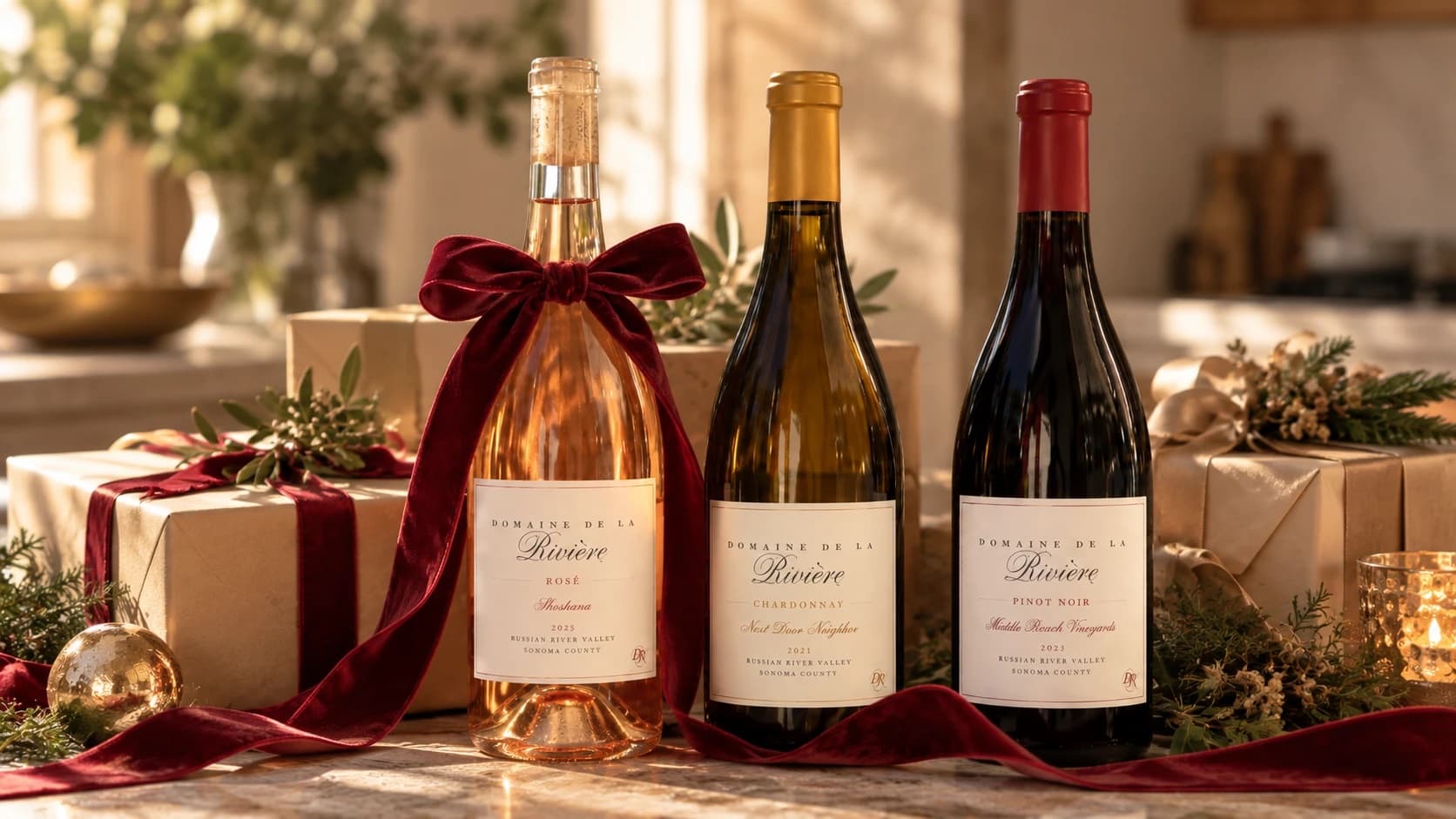
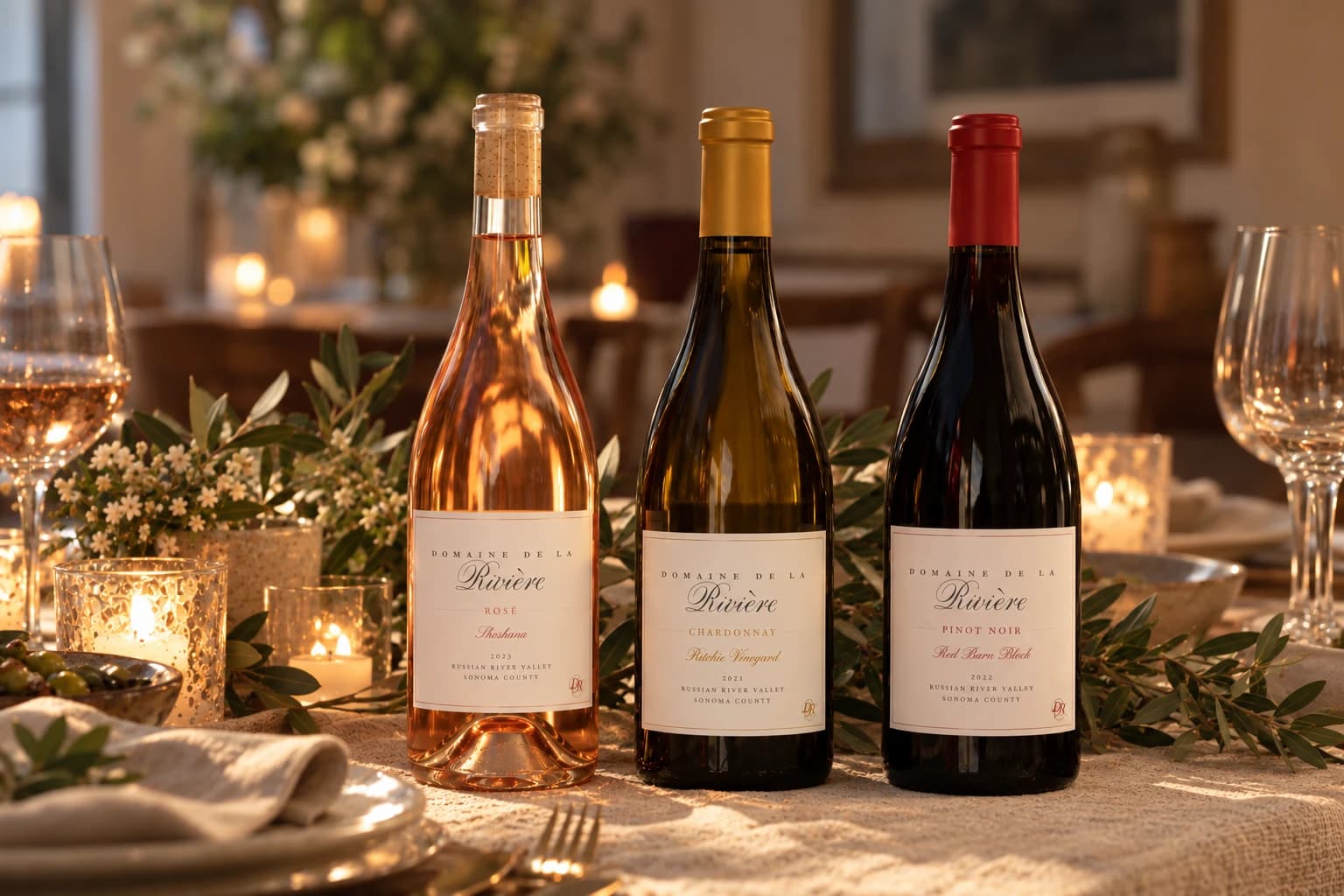
A good wine to give as a gift suits the recipient and the occasion. When their taste is unknown, a versatile crowd-pleaser is the safe choice: a medium-bodied Pinot Noir, a balanced Chardonnay, or a dry Rosé from a defined region, in the $40 to $75 range. For a dedicated wine lover, a single-vineyard bottle, a tasting, or a membership means more. Domaine de la Rivière, a Russian River Valley family estate, sends three bottles most often: Shoshana Rosé of Pinot Noir for a thank-you, Ritchie Vineyard Chardonnay for a Chardonnay lover, and Two Forces Pinot Noir for a collector.
Below: the wine gifts we send, what makes a good wine gift, what to give when you don't know someone's taste, whether red or white is safer, how much to spend, how to read a label or score, whether a bottle, a magnum, a set, or a membership fits, how to present it, what a real wine lover wants, and when an experience beats a bottle.
The wine gifts we send
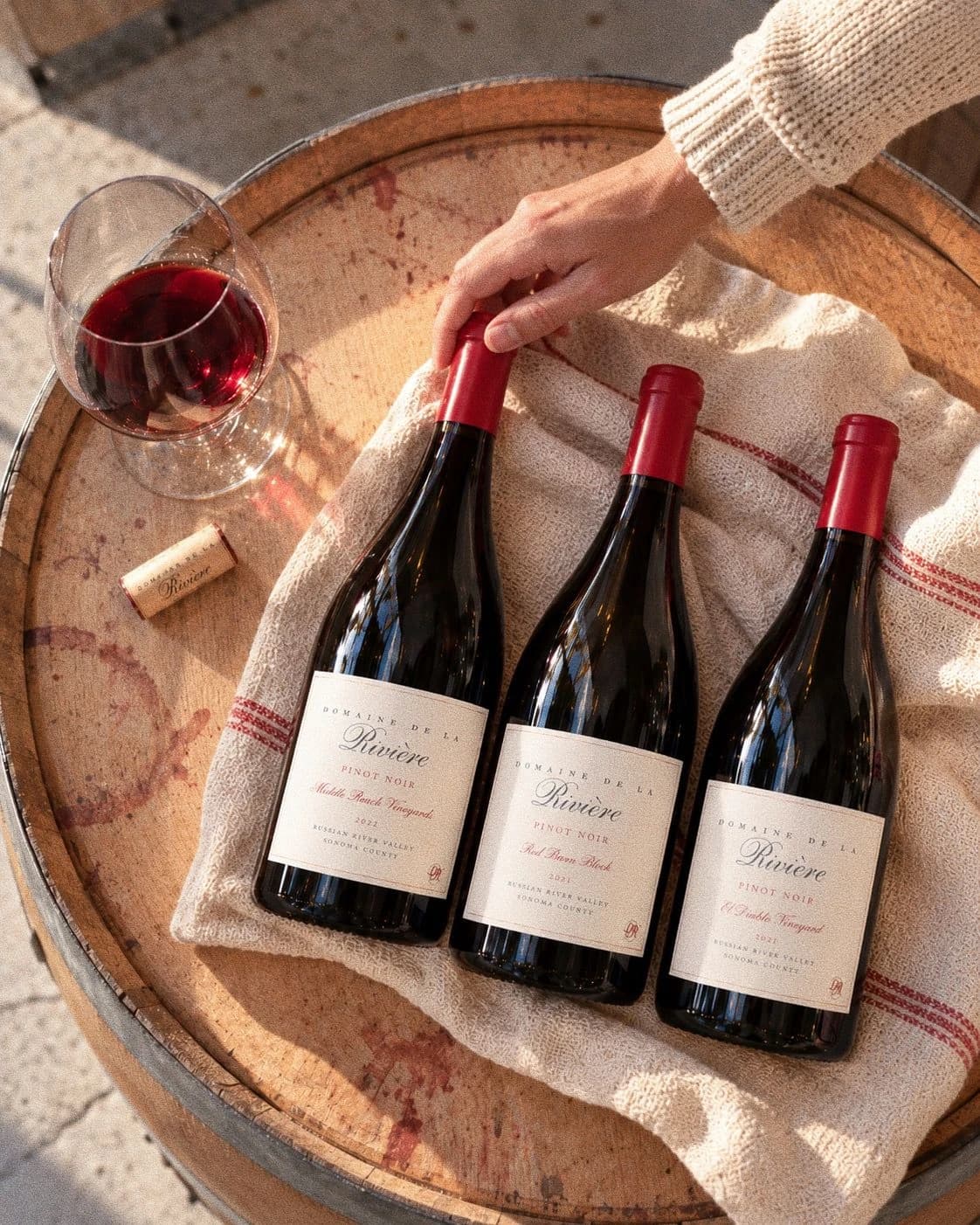
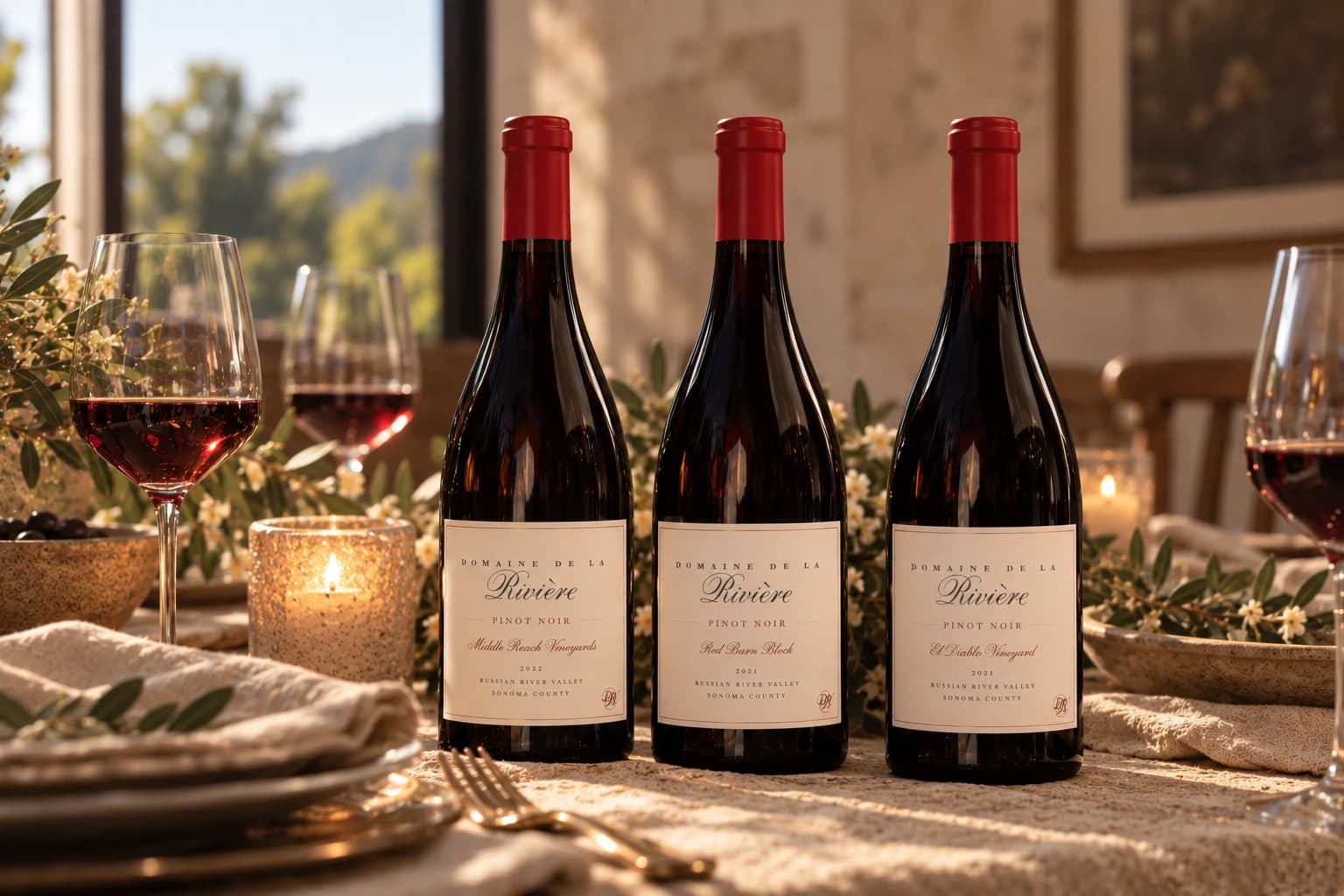
Here is the short version. These are the bottles we send most as gifts, from our own estate in the Russian River Valley — matched to who is receiving them, and shipped with a handwritten note. The reasoning behind the choices follows below.


Shop the Set
Curated collections
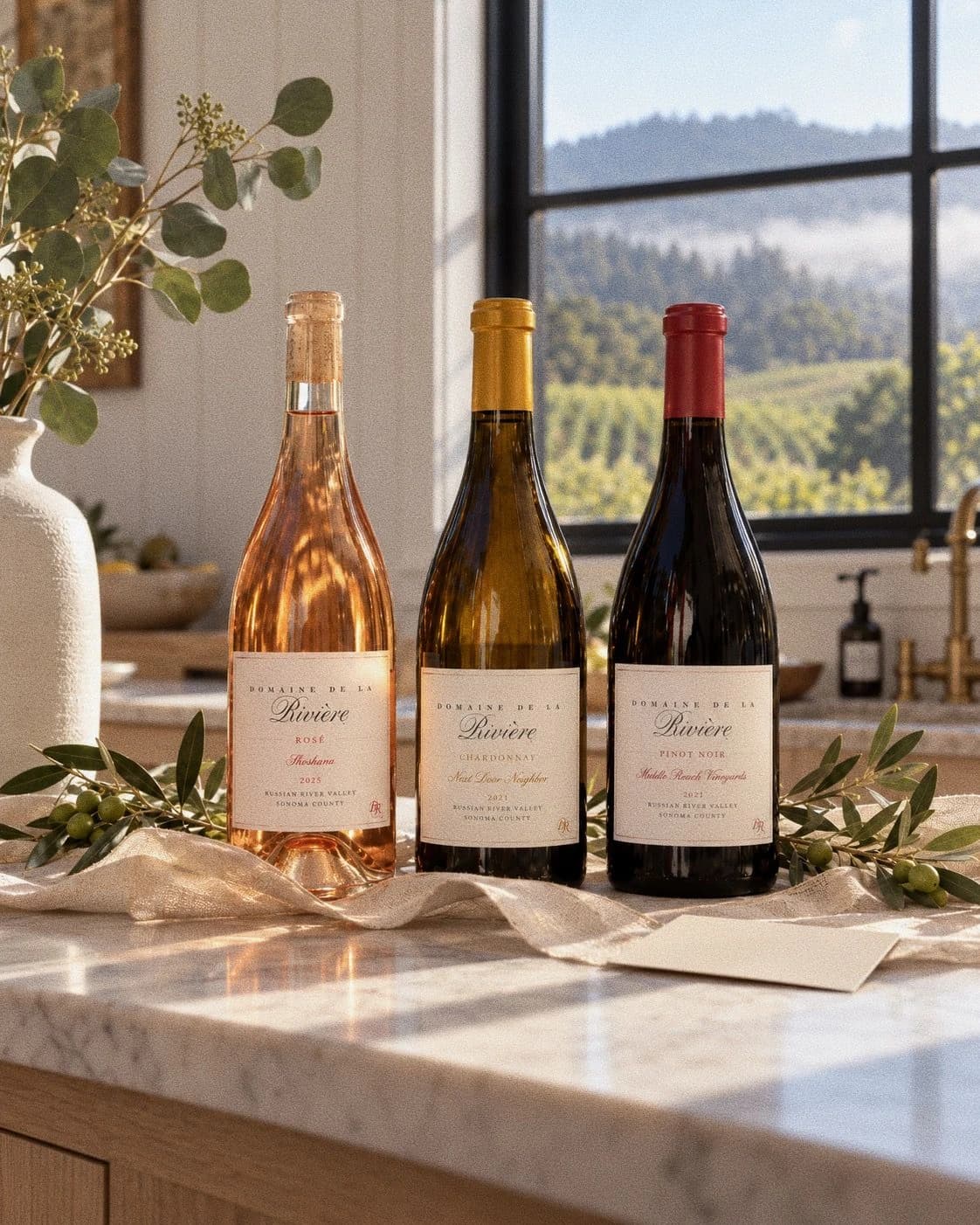
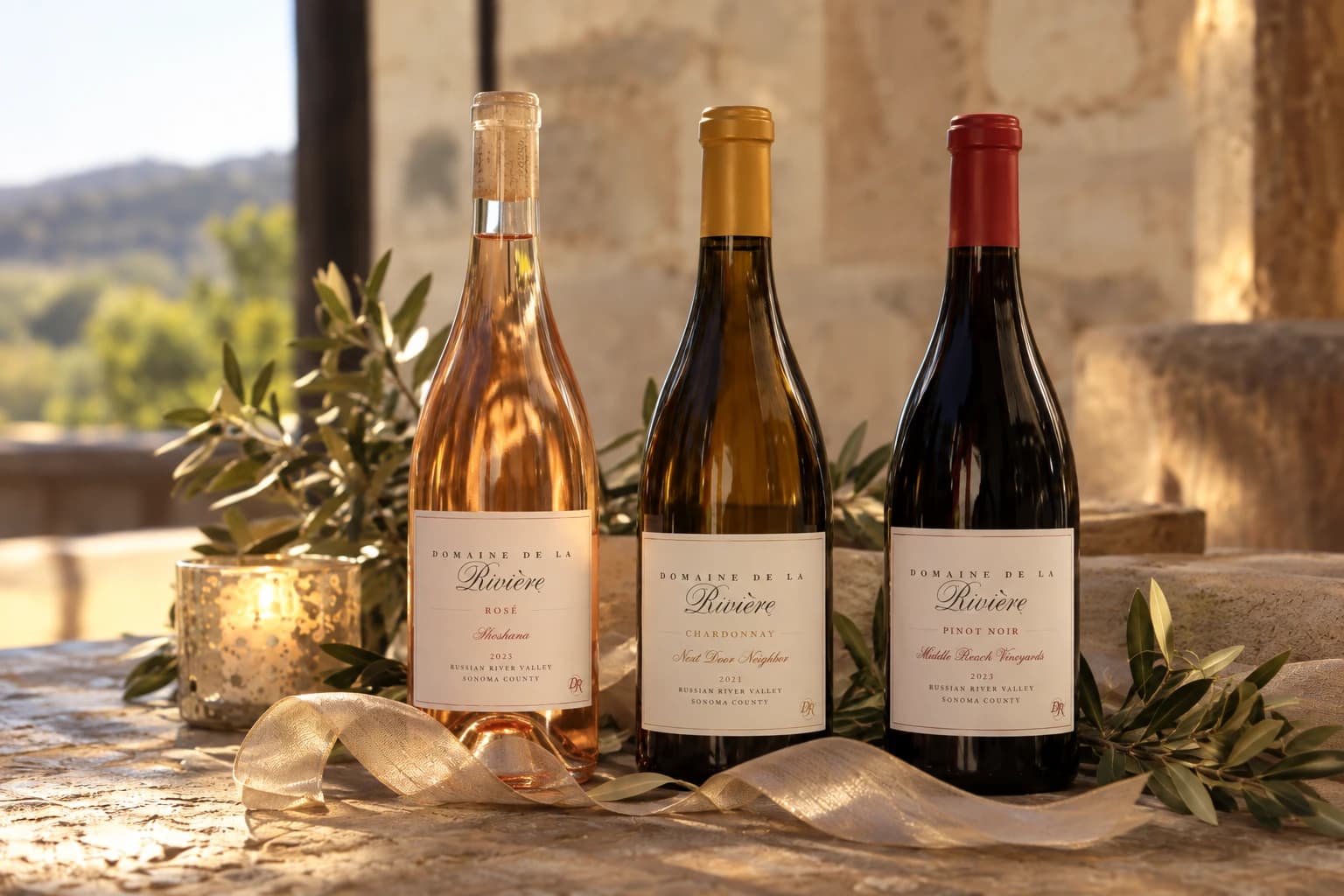
Sending to a team or a list of people? The family etches bottles with a logo or names and ships to many addresses at once.
Custom & Corporate GiftsWhat makes a good wine gift?
A good wine gift fits the recipient and the occasion rather than the price tag. The strongest choices are versatile and food-friendly, come from a defined region, are made in limited quantity by a named producer, and match how the person actually drinks. Start with the drinker and the moment, then choose a well-made wine that suits both.
Four things separate a wine gift that lands from one that gets shelved. It should be drinkable now or clearly meant for cellaring, and the giver should know which. It should come from somewhere specific — an appellation, ideally a single vineyard — because place gives the recipient something to talk about. It should be scarce enough that they could not have found it at the grocery store. And it should arrive intact, with a note.
- Match the drinker: reds point to Pinot Noir, whites to Chardonnay, and something light and easy to a dry Rosé.
- Match the occasion: a celebration suits a wine to cellar and open later; a thank-you or housewarming suits a bottle to enjoy soon.
- Favor versatility: a wine that flatters a table of mixed tastes and pairs with a range of food rarely misses.
- Provenance reads as considered: a limited-production wine from a single region or vineyard tells a story a mass-market label can't.
- Check the delivery: wine ships to most U.S. states, but an adult 21 or older must sign, and it can't go to a P.O. box.
What wine should you give if you don't know their taste?
When the recipient's taste is unknown, three styles are dependable. A medium-bodied Pinot Noir is the easiest red to give — aromatic and food-friendly, it suits people who avoid big, tannic reds. A balanced, lightly oaked Chardonnay flatters most white drinkers. A dry Rosé is bright, versatile, and welcome nearly any time of year.
| If they lean toward... | A safe style | Why it works |
|---|---|---|
| Reds, or a bit of everything | A cool-climate Pinot Noir | Aromatic and medium-bodied, with fresh acidity and soft tannin — among the most universally welcome reds, and good with salmon, roast chicken, and mushrooms alike. |
| White wine | A balanced Chardonnay | Citrus and orchard fruit over a savory core — refined without being heavy or overly oaked. Pairs with poultry, shellfish, and cream sauces. |
| Something light and easy | A dry Rosé | Crisp, dry, and versatile. Hard to dislike, ready to open the day it arrives, and suited to warm weather, brunch, and appetizers. |
| Big, bold reds | A structured single-vineyard Pinot Noir | A Pinot from a warmer site or riper vintage gives weight without the heavy tannin that makes Cabernet a gamble. |
Cool-climate regions are a useful shortcut. Pinot Noir and Chardonnay from fog-cooled places such as the Russian River Valley, the Sonoma Coast, the Willamette Valley, or Burgundy carry brighter acidity and more restraint than the same grapes from warmer areas, which makes them easier to pair with food and easier to like across palates. A label that names a vineyard is another sign the producer works at a small scale.
If you want a name rather than a style: for the crowd-pleaser, we'd hand you our Shoshana Rosé. It's whole-cluster pressed, dry, made in about 100 cases, and named for our daughter; the 2024 scored 93 from The Tasting Panel, and the 2020 won Best of Show at the NOLA Food & Wine Experience's Tournament of Rosé. For the red drinker, our Middle Reach Vineyards Pinot Noir 2021 (94, Wine Enthusiast Cellar Selection; Double Gold, San Francisco Chronicle) is the one we open when we don't know the table.
Is red or white the safer choice?
Neither is universally safer — the safer choice follows the person. If they favor reds, a medium-bodied Pinot Noir is a widely welcome pick; for white drinkers, a balanced Chardonnay. When their preference is genuinely unknown, a dry Rosé bridges the two, or a Chardonnay-and-Pinot pair covers both bases in one gift.
Body matters as much as color. A lighter, higher-acid red is easier to give than a dense, tannic one, because it suits more palates and more foods; the same logic favors a fresh, less-oaked white over a heavy, buttery style. Season plays a part too: Rosé and Chardonnay suit spring and summer, while Pinot Noir is the natural choice for autumn and the winter holidays. For the committed Chardonnay lover, the bottle we'd reach for is our Ritchie Vineyard Chardonnay — old vines planted in 1972 — whose 2022 scored 96 from The Tasting Panel and 95 with an Editor's Choice from Wine Enthusiast; our Next Door Neighbor Chardonnay 2021 (93 and Editor's Choice, Wine Enthusiast) is the lighter, everyday-priced sibling.
How much should you spend on a wine gift?
Most thoughtful wine gifts fall between $40 and $110 a bottle. Under $40 buys a good regional wine; $40 to $75 is where limited-production, appellation-labeled wines from small producers live; $75 to $150 covers single-vineyard and collector bottlings. Fit matters more than price — a well-chosen bottle reads as more considered than an expensive familiar label.
For a sense of scale, our own bottles run $40 to $110 — the Rosé and Chardonnays at the lower end, the single-block Pinots at the top — which is about where most small Russian River Valley estates sit.
| Price band | What it typically buys | Best suited to |
|---|---|---|
| Under $40 | A well-made regional wine from a larger producer. | A host gift, a casual thank-you, or one bottle of several. |
| $40–$75 | Limited-production, appellation-labeled Pinot Noir, Chardonnay, or Rosé from a family or boutique winery. | The dependable center: birthdays, housewarmings, client thank-yous, holiday gifts. |
| $75–$150 | Single-vineyard or single-block bottlings, often with critic scores and years of cellaring ahead. | A milestone, a serious enthusiast, or a bottle meant for a future anniversary. |
| $150 and up | Magnums, verticals, library releases, or a case. | Weddings, retirements, and the collector who has most things. |
| Occasion | A fitting choice |
|---|---|
| Wedding or milestone | A case, a magnum, or a vertical of an age-worthy Pinot Noir to toast now and cellar for anniversaries to come. |
| Thank-you or host gift | A single bottle of dry Rosé or Chardonnay — bright, generous, and ready to open. |
| Housewarming | A Chardonnay-and-Pinot pair to christen a new table. |
| The holidays | A structured, cellar-worthy red, shipped in time for the table. |
| Corporate or client | A consistent bottle or two-bottle set sent to a list of addresses, with a personal note. |
How do you read a wine label or score when choosing a gift?
Three things on a label tell you most of what you need: the appellation (the narrower, the better), the vintage, and whether a vineyard is named. Scores from established critics — Wine Enthusiast, Wine Spectator, The Tasting Panel — and medals from blind competitions such as the San Francisco Chronicle's are a useful tiebreaker; 90 and above generally marks a wine worth giving.
Scores confirm a choice rather than make it. A 94-point Pinot Noir and a 94-point Cabernet are both well made, but only one suits a guest who dislikes tannin. Competition results — Double Gold, Best of Class, Best of Show — mean a panel agreed on the wine blind, a stronger signal than a single reviewer; Wine Enthusiast's Editor's Choice and Cellar Selection designations point to value and age-worthiness respectively. One or two verifiable accolades on a wine already chosen for style is the right amount of reassurance.
Vintage matters more for cellar gifts than for bottles to be opened soon. A current-release Rosé or Chardonnay should be from the most recent one or two vintages; a Pinot Noir meant for an anniversary in five or ten years should come from a producer whose wines are known to age, ideally from a cooler vintage with good acidity.
Should you give a bottle, a magnum, a set, or a membership?
A single bottle suits most occasions and casual drinkers. A two- or three-bottle set covers mixed tastes or a couple. A magnum — two bottles in one — is the choice for a party or wedding, and ages more slowly. A membership sends new releases through the year; a case marks a milestone. Choose the format by how the recipient drinks.
| Format | Best for | Worth knowing |
|---|---|---|
| Single bottle | Thank-yous, hosts, birthdays, most casual drinkers. | Ships light; easiest to time and present. Most gifts should be this. |
| Two- or three-bottle set | Couples, housewarmings, anyone split between red and white. | A Pinot-and-Chardonnay pair is the classic; add a Rosé for three. |
| Magnum (1.5 L) | Weddings, dinner parties, milestone birthdays. | Less air per volume, so it ages more slowly; makes an impression on the table. Not every wine is bottled in magnum. |
| Half-case or case | Weddings, retirements, a new home with a cellar. | One box; a mixed case lets the recipient explore a producer's range. |
| Etched bottle | Weddings, engagements, anniversaries, company gifts. | A name, date or logo etched into the glass, so the bottle is kept after the wine is gone. Priced by quantity, wine and bottle size; we etch our own wine. |
| Membership | The enthusiast who would rather have discovery than a single bottle. | Typically two to four shipments a year with member pricing; can be set up in the recipient's name. |
| Tasting experience | Travelers, couples, anyone who would enjoy the visit more than the object. | Seated tastings at small estates are by reservation; the giver books and pays on the recipient's behalf. |
How should you present or wrap a wine gift?
For a wine given in person, a plain wooden box, a linen bag, or tissue and a handwritten note is enough — the bottle is the gift. For a wine that ships, presentation happens through the note: most winery checkouts print a gift message and hide prices, and the box arrives from the winery rather than a gift-basket aggregator.
Do not gift-wrap a bottle that is being shipped; it travels in a molded shipper and any wrapping comes off for packing. Include a line about when to open it — "drink this summer" or "put this away for your tenth anniversary" turns a bottle into an instruction. For several bottles, a short card saying what each is and why you chose it does more than a ribbon. For a serious enthusiast, skip the gift basket: cheese and a corkscrew dilute a good bottle.
What's a good wine gift for a real wine lover?
For a dedicated enthusiast, provenance and rarity matter more than a well-known name. A limited-production wine from a single vineyard or a cool-climate region gives them something to explore rather than simply drink. A structured, age-worthy bottle to cellar, or a vertical of the same wine across vintages, lands better than a crowd-pleaser.
Think in terms of what they cannot easily buy themselves. Single-block bottlings — wine from one section of one vineyard — are often made in a few hundred cases and sold mostly through the winery. Library releases, older vintages held back by the producer, show how a wine ages without the wait. A pair of the same wine, one to open now and one to keep, is a classic collector's gift. Each says the giver understood the difference between a good bottle and an interesting one.
From Domaine de la Rivière's cellar, the collector's bottle is the Two Forces Pinot Noir 2021, which scored 95 from Wine Enthusiast and took a Double Gold at the American Fine Wine Competition; the Heritage Block Pinot Noir 2021 (95, Cristaldi Report, No. 66 of its Top 100 Wines of 2025; Gold, San Francisco Chronicle) is another to lay down. Both come off Vineyard eleven, 11 acres of estate Pinot planted to four clones, and both are built to sit for years.
An experience is the other strong option. A seated tasting lets a wine lover taste comparatively and learn how a region is shaped, and a winery membership delivers new releases through the year — a gift that keeps unfolding after the occasion has passed.
Is a bottle or an experience the better gift?
A bottle is immediate and personal; an experience lasts longer. A single well-chosen bottle suits most occasions and casual drinkers. For someone who truly loves wine, an experience — a seated tasting or a membership that arrives as new releases through the year — often means more than any one bottle, because it unfolds over time.
The deciding factor is the recipient. A host, a new couple, or a casual drinker is best served by a bottle to open soon. A collector or enthusiast tends to value the discovery of a tasting or the anticipation of a recurring shipment. A membership also solves the problem of not knowing which bottle to pick: the winery chooses, and the giver is remembered each time a box arrives. Ours works that way too — Les Clubs comes as a half-case (Friends de la Rivière) or a full-case (Concierge de la Rivière), shipped twice a year in the recipient's name, and a seated tasting for two to eight in Windsor can be booked and paid for on someone's behalf. Either ships to most U.S. states through Vinoshipper, with an adult 21 or older signing and no P.O. boxes; for a handwritten card or several addresses, email marla@domaineriviere.com and we'll arrange it ourselves.
Whatever you land on, our wine gifts are at the top of this page — and we can ship any of them with a handwritten note, to one address or many. Just tell us the occasion.
Send a Wine GiftFrequently asked questions
- What's a good wine to give as a gift?
- A good gift wine suits the recipient and the occasion. When their taste is unknown, choose a versatile crowd-pleaser: a medium-bodied Pinot Noir for red drinkers, a balanced Chardonnay for white drinkers, or a dry Rosé for something bright and easy. A limited-production wine from a single region, in the $40 to $75 range, reads as especially considered.
- What wine should you give someone whose taste you don't know?
- A medium-bodied, cool-climate Pinot Noir is the safest red — aromatic, food-friendly, and rarely too bold. For white drinkers, a balanced, less-oaked Chardonnay. A dry Rosé is the easiest all-rounder. A Pinot-and-Chardonnay pair covers both in one gift.
- Is red or white wine a safer gift?
- Neither is universally safer; the safer choice follows the person. If they favor reds, a medium-bodied Pinot Noir is widely welcome; for white drinkers, a Chardonnay. If their taste is unknown, a dry Rosé bridges the two, or a Chardonnay-and-Pinot pair covers both.
- How much should you spend on a wine gift?
- Most thoughtful wine gifts fall between $40 and $110 a bottle. $40 to $75 buys limited-production, appellation-labeled wine from a small producer; $75 to $150 buys single-vineyard bottlings for a milestone or a serious enthusiast. Fit matters more than price.
- What do wine scores mean when choosing a gift?
- Scores from established critics and blind competitions are a useful tiebreaker, with 90 and above generally marking a wine worth giving. Use them to confirm a wine you have already chosen for style — a high score on a tannic red will not please someone who prefers lighter wines.
- Is a magnum a good wine gift?
- For a wedding, a dinner party, or a milestone birthday, yes. A magnum holds two bottles' worth, ages more slowly because there is less air per volume, and makes an impression on the table. For a single recipient who drinks casually, a standard bottle or a two-bottle set is more practical.
- What's a good wine gift for someone who really loves wine?
- Give what they cannot easily buy themselves: a single-vineyard or single-block bottling, a library release, or a pair of the same wine to open now and cellar. An experience — a seated tasting or a winery membership that arrives through the year — often means more than a single bottle.
- Is a bottle or an experience the better wine gift?
- A bottle is immediate and suits most occasions and casual drinkers. For someone who truly loves wine, an experience — a seated tasting or a membership that delivers new releases through the year — often lasts longer and means more. The recipient decides which fits.
- Can a wine gift be shipped to the recipient?
- Yes. Wine ships to most U.S. states through a licensed shipper that handles compliance. An adult 21 or older must be present to sign at delivery, and orders cannot go to a P.O. box. For a note or an order to several addresses, contact the winery directly.
References