
Russian River Valley Pinot Noir is a cool-climate red from Sonoma County, California, shaped by nightly Pacific fog. Slow ripening over a long season gives wines of red cherry and raspberry, floral and tea-leaf aromatics, bright acidity, and fine, silky tannin — supple enough to drink young, structured enough to age for a decade or more. It is the wine Domaine de la Rivière, a New York family's estate in the Middle Reach, is built on.
Below: how the fog actually works, what Pinot Noir tastes like here, how it differs from Pinot grown elsewhere in California, which clones and soils matter, how the wine is made, and how to serve, decant, cellar, and pair it. Where one of our own blocks is the clearest example, I use it.
What makes Russian River Valley Pinot Noir different?
Fog, soil, and time. Most nights, marine fog is pulled inland from the Pacific and settles over the valley until mid-morning, so the vines ripen in a long, cool season. Well-drained Goldridge sandy loam keeps yields modest, and the result is Pinot Noir that holds its natural acidity and perfume while still ripening fully.
How the fog works
The Russian River Valley sits about 20 miles from the ocean, but two openings in the coastal hills connect it to the cold Pacific: the Petaluma Gap to the south and the river's own canyon to the west, where the Russian River cuts through the coast range on its way to the sea at Jenner. As inland Sonoma heats up during the day, that warm air rises and draws a marine layer in through both gaps. The fog typically arrives in the evening, blankets the valley floor overnight, and burns off between nine and eleven the next morning.
The effect is a large daily temperature swing — commonly 35 to 40 degrees Fahrenheit between a summer afternoon and the following dawn. Warm afternoons ripen the fruit and build flavor; cold nights slow sugar accumulation and preserve malic acid, the sharp acid that gives young Pinot its lift. Harvest usually runs from late August into early October, so the grapes hang longer at moderate sugars.
Why the soil matters
The valley's signature soil is Goldridge, a fine sandy loam formed from ancient marine sediment. It drains quickly, holds little water, and is low in nutrients, so vines planted in it grow modestly, set small clusters, and put their energy into fruit rather than leaves. Along the river itself the picture is more mixed — loam and gravel on the benches, heavier clay in the low spots — and those differences show up in the glass as variations in weight and tannin from one block to the next.
Pinot Noir is a thin-skinned, early-ripening grape that reflects where it was grown more faithfully than almost any other. In a warm climate it turns soft and simple; in a cold one it may never ripen. The Russian River Valley — an American Viticultural Area established in 1983 — sits in the narrow band between those extremes, which is why it is widely regarded as a benchmark California region for the grape.
What does Pinot Noir taste like?
Pinot Noir is a light- to medium-bodied red with red-fruit flavors — cherry, raspberry, cranberry — floral and spice aromatics, and an earthy, savory undertone. It has higher acidity and softer, finer tannin than Cabernet Sauvignon or Syrah, so it feels silky rather than grippy. Russian River Valley examples add ripe fruit, tea-leaf and rose notes, and marked freshness.
| Character | What you may notice in Russian River Valley Pinot Noir |
|---|---|
| Fruit | Red cherry, raspberry, pomegranate, cranberry; black cherry and plum in warmer blocks and vintages. |
| Aromatics | Rose petal, violet, dried flowers, black tea, baking spice — the perfume the cool climate protects. |
| Savory notes | Forest floor, mushroom, wet stone, a hint of cola or cured meat that builds with age. |
| Structure | Medium body, bright acidity, fine silky tannin; alcohol usually 13–14.5 percent. |
| With age | Fruit settles into dried cherry and orange peel; earth, truffle, and tea come forward over 5–10+ years. |
Compared with Burgundy, the grape's home, Russian River Valley Pinot Noir is generally riper and more fruit-forward, with a rounder texture and a touch more alcohol. Compared with warmer California Pinot Noir, it is more aromatic and noticeably fresher. Critics describing the region's wines tend to reach for the same vocabulary — red cherry, rose petal, black tea, forest floor — because those are the markers the climate produces.
Two of our own blocks show how wide that range is within a single mile of river. Heritage Block, the oldest parcel of Domaine de la Rivière's Vineyard eleven, sits under the heaviest morning fog and comes in at 13.1 to 13.8 percent alcohol; it is the most perfumed wine we make, and the Cristaldi Report's note on the 2021 — "violet and rose petal" with "black tea, bergamot, orange peel" — is about as good a description of fog-grown Pinot as I have read. El Diablo, a steep ridge site up the hill, gets more sun and gives the opposite: darker fruit, firmer tannin, real power. I mention that the 2021 Heritage Block earned 95 points from the Cristaldi Report — No. 66 on its Top 100 Wines of 2025 — and a Gold at the San Francisco Chronicle mostly because it makes a point I care about — the lighter, lower-alcohol wine can be the serious one.
How is it different from other California Pinot Noir?
Mostly climate. California grows Pinot Noir from the warm interior to the cold, fog-bound coast, and the cooler the site, the fresher and more red-fruited the wine. The Russian River Valley sits toward the cooler end — riper than the true Sonoma Coast, fresher than warmer inland districts — so its Pinot combines generous fruit with acidity and perfume intact.
| Region | Climate | Pinot Noir tends toward |
|---|---|---|
| Russian River Valley | Cool, foggy nights; warm afternoons | Ripe red fruit, floral and tea aromatics, bright acidity, silky tannin — the balanced middle. |
| Sonoma Coast / West Sonoma Coast | Cold, windy, marine | Leaner, higher-acid, more tart cranberry and herb; lower alcohol. |
| Anderson Valley | Cool, coastal (Mendocino) | Bright, savory, red-fruited; often earthier and lighter than Russian River. |
| Sta. Rita Hills | Cold, coastal (Santa Barbara) | Intense, high-acid, darker-fruited and structured. |
| Warmer inland districts | Moderate to warm | Fuller, darker, softer — more plum and black cherry, less lift. |
Within the Russian River Valley itself, wines still vary. Fog reaches the western and southern edges most reliably, so the Green Valley of Russian River Valley — a cooler AVA nested inside the larger one — gives more delicate, higher-acid wines. Growers also speak of informal neighborhoods, among them the Middle Reach — the stretch of river between southern Healdsburg and Forestville, where our vineyard sits — and Laguna Ridge to the southwest. Each has its own balance of fog, soil, and exposure.
Which Pinot Noir clones are grown in the Russian River Valley?
Four heritage selections dominate: Pommard, Swan, Mt. Eden, and the so-called Vosne-Romanée selection, alongside the Dijon clones (115, 667, 777, 828) planted widely since the 1990s. A clone is a genetically distinct line of the same grape, and each brings its own cluster size, ripening curve, and aromatic signature. Most serious vineyards plant several and blend.
| Clone | Origin | What it brings |
|---|---|---|
| Pommard (UCD 4/5) | Brought to UC Davis from Burgundy in the mid-twentieth century | Structure, darker fruit, spice, and a firmer tannic frame; the backbone of many blends. |
| Swan | Selected by Joseph Swan in the Russian River Valley from Burgundian cuttings | Small clusters, perfume, red fruit, and elegance; ripens with modest sugar. |
| Mt. Eden | From the Mt. Eden vineyard in the Santa Cruz Mountains, of Burgundian origin | Tiny yields, intense aromatics, energy and tension; among the most age-worthy selections. |
| Vosne-Romanée selection | A heritage selection associated with the Burgundy village of the same name | Concentration, dark red fruit, and floral lift; suits powerful hillside sites. |
| Dijon 115 / 667 / 777 / 828 | Certified French clones released from Dijon in the 1980s–90s | Reliable ripening, plush fruit, and softer tannin; often used to round out blends. |
The heritage selections ripen later and more unevenly than the Dijon clones, which is why growers value them in a cool climate: the extra hang time develops flavor at moderate sugar. Most newer plantings here sit on a low-vigor rootstock such as 101-14 and are cane pruned, which keeps the canopy open and the crop small.
At Domaine de la Rivière's Vineyard eleven, all four heritage selections grow — Pommard, Swan, Mt. Eden, and Vosne-Romanée — on 11 acres of Goldridge and loam planted in 2016 and 2018. I keep every block separate through fermentation so I can taste what each clone is doing before I decide anything. Swan and Mt. Eden are the perfume and tension in Heritage Block; Pommard, Swan, and the Vosne-Romanée selection give Red Barn Block its broader shoulders. Same soil, same fog, a few rows apart, and they are plainly different wines.
How is Russian River Valley Pinot Noir made?
Gently. Pinot Noir is fermented in small, open-top tanks with a portion of whole clusters, often on native yeast, then aged 10 to 18 months in French oak barrels — typically 25 to 50 percent new. Because the fruit arrives with acidity intact, winemakers here can intervene less and let the vineyard, rather than the cellar, define the wine.
- Pick on flavor and acidity. Fruit is harvested at night or in the cool morning, usually at moderate sugar, when the seeds have browned and the fruit tastes of ripe cherry rather than raisin.
- Sort and decide on whole clusters. Clusters are sorted by hand. Some are left whole — stems included — to add spice, floral lift, and tannin; the rest are destemmed. Anywhere from zero to a third whole cluster is common here.
- Ferment slowly on native yeast. A cold soak of a few days extracts color and aroma before fermentation begins. Many small producers let the vineyard's own yeasts start the ferment, which runs cooler and longer and adds savory complexity.
- Press lightly and settle. After one to three weeks on the skins, with gentle punch-downs, the wine is pressed softly to keep tannin fine and moved to barrel while still cloudy.
- Age in French oak, then bottle unfined. Ten to eighteen months in French oak — a third or so new is a common measure — softens the wine without masking it. Most estates bottle unfined and lightly filtered, or not filtered at all.
Whole-cluster share, new-oak share, and time on the skins are the levers that most change the style: more of each means spice, structure, and weight; less keeps the wine transparent and red-fruited.
For what it is worth, that is close to what we do at home. We ferment on native yeast in small lots, keep whole cluster modest, and age the estate wines about a year in roughly 35 percent new French oak — enough to soften the wine, not enough to hear the barrel over the vineyard. I would rather the fog get the credit than the cellar.


Shop the Set
Curated collections
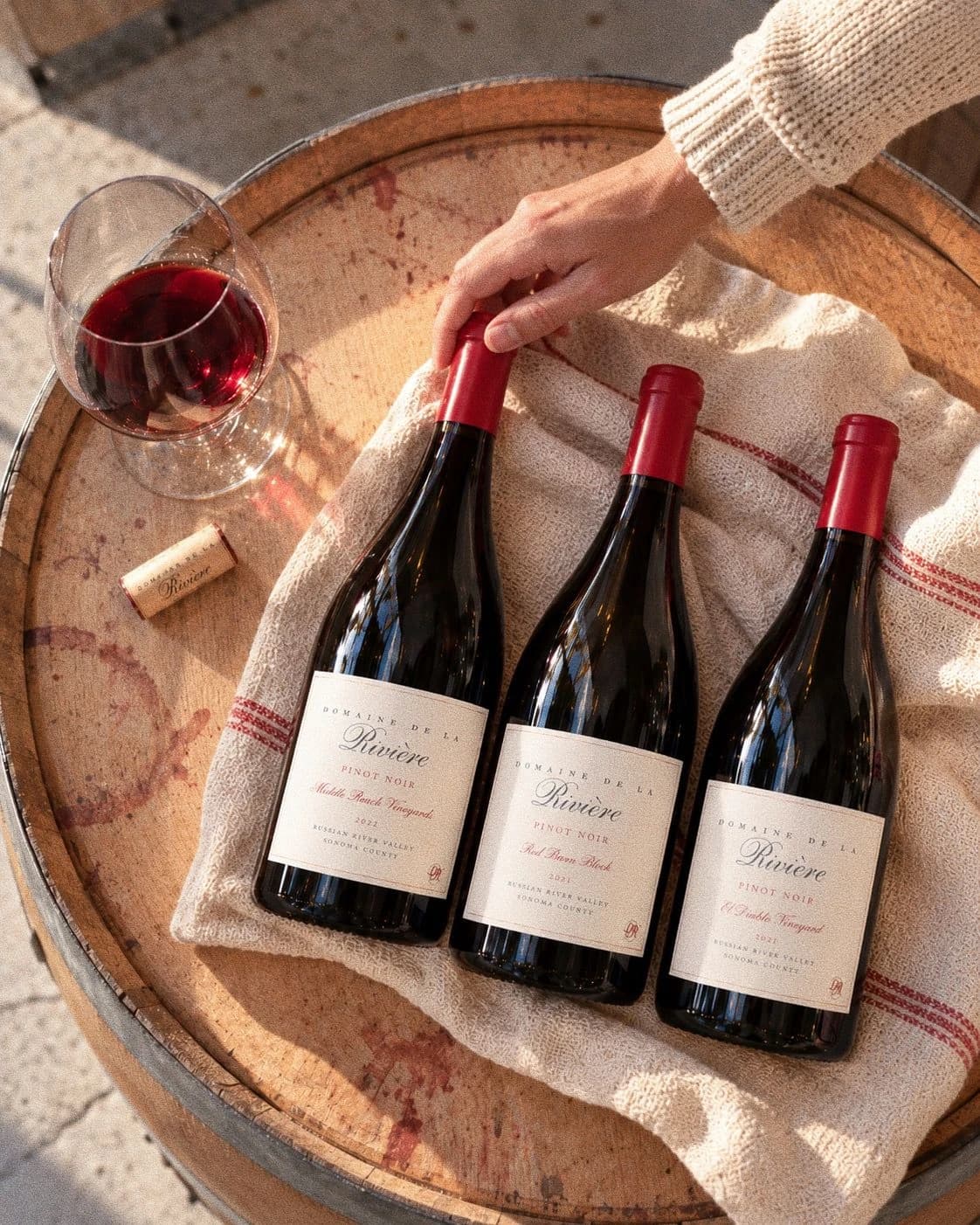
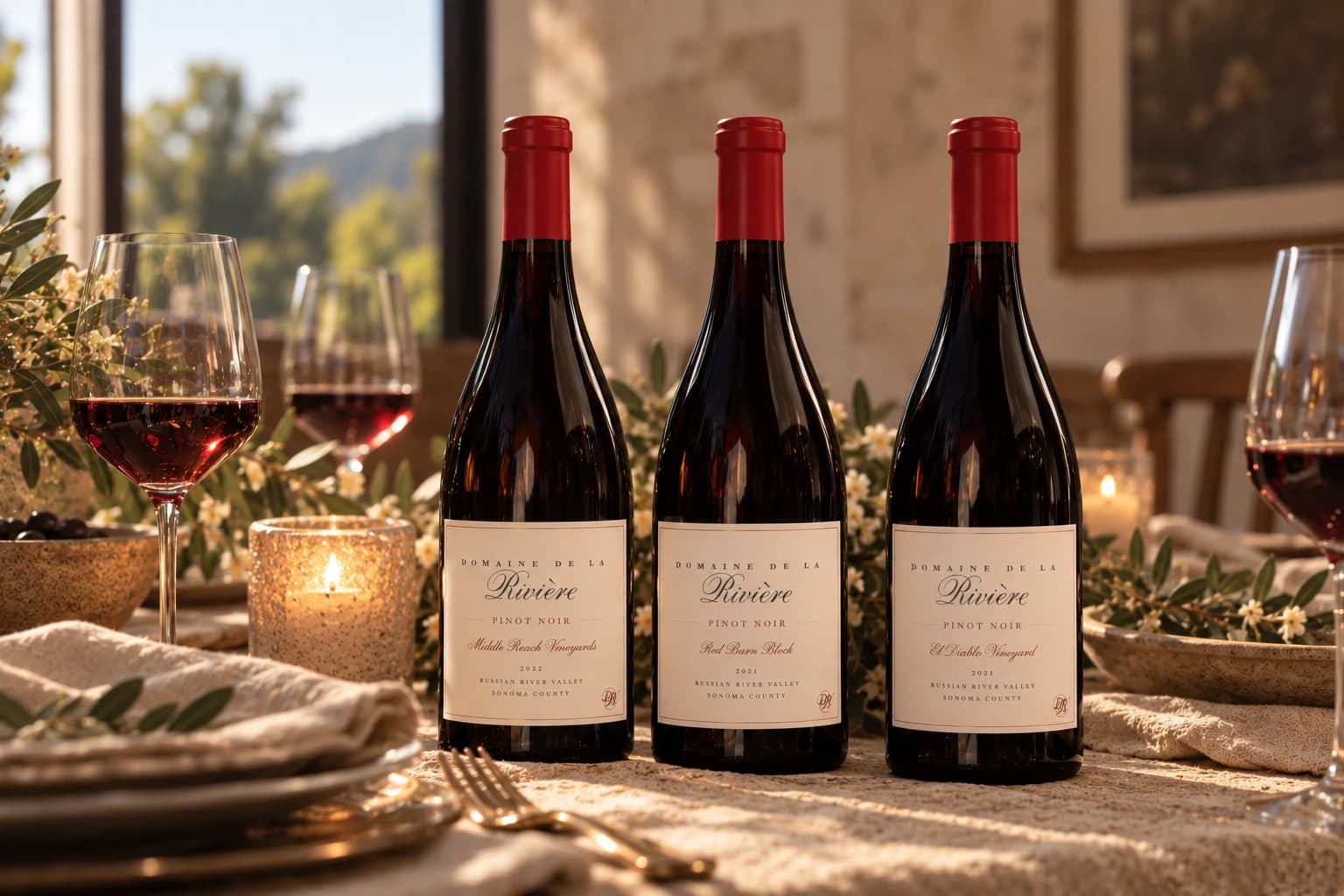
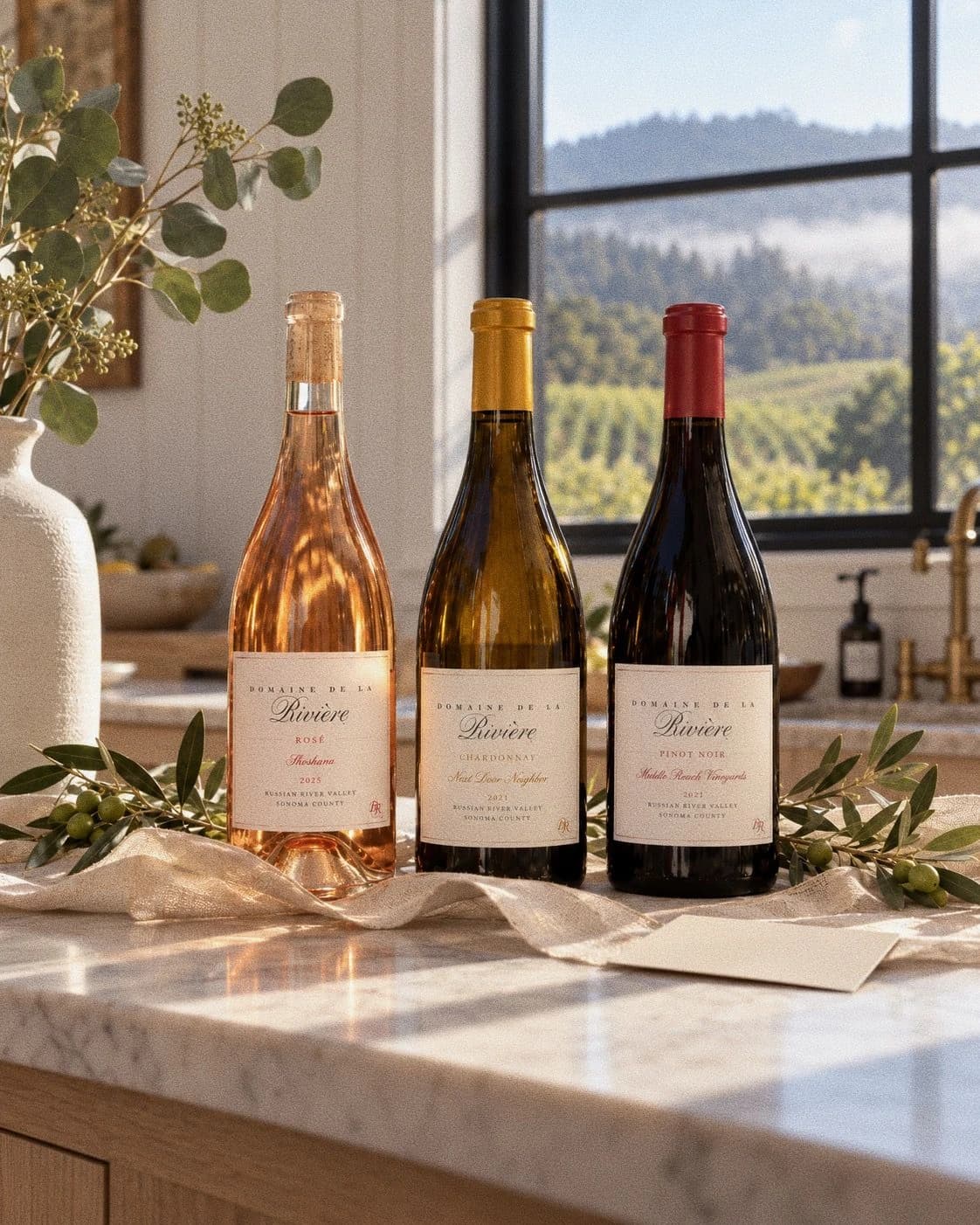
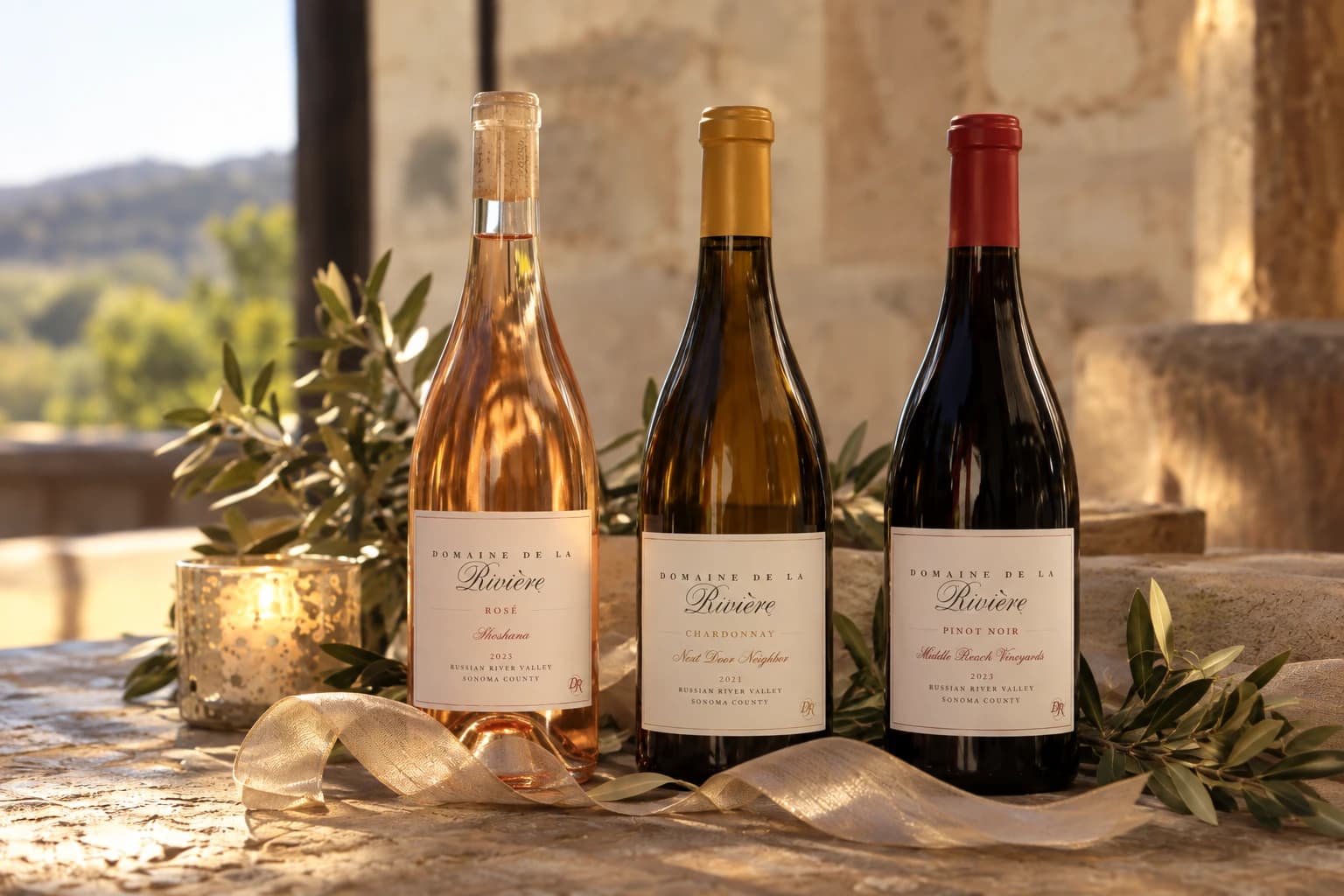
How do you serve Pinot Noir?
Serve Pinot Noir slightly cool, at 55–60°F (13–16°C), in a wide-bowled glass. That is cooler than most rooms, so twenty minutes in the refrigerator before pouring is usually right. Served too warm, Pinot tastes flat and alcoholic; too cold, its aromatics close down. Open the bottle a little ahead of time and pour to the widest point of the glass.
- Temperature: 55–60°F (13–16°C). Warmer than that flattens the aromatics and emphasizes alcohol; a short chill sharpens the fruit and acidity.
- Glass: a wide Burgundy bowl gathers Pinot's perfume and directs it to the nose; fill only to the widest point so there is room to swirl.
- Opened bottles: recork and refrigerate; most Pinot Noir holds well for two days and often improves on the second.
Should you decant it?
Optional, and it depends on age. A young, structured Pinot Noir benefits from 30–60 minutes of air — in a decanter or simply an open glass — which softens tannin and opens the aromatics. Older bottles need less time and are more fragile: decant them gently just before serving, mainly to leave sediment behind, and drink them sooner.
As a rule, the younger and more tightly wound the wine, the more air helps; the older and more delicate, the less it needs. If you are unsure, pour a small glass first. If it seems closed or tight, give the rest more time open; if it already shows fruit and perfume, it does not need a decanter.
How long does Russian River Valley Pinot Noir age?
Most well-made Russian River Valley Pinot Noir drinks well from release through about eight years, and structured single-vineyard bottlings can go ten to fifteen. Acidity, moderate alcohol, and fine tannin are what carry it. Store bottles on their side in the dark at a steady 55°F, and expect the fruit to turn savory and the texture silkier with time.
| Age from vintage | What to expect |
|---|---|
| 1–3 years | Primary: bright cherry and raspberry, floral lift, fresh acidity, a little oak spice still visible. |
| 4–8 years | Integrated: fruit deepens to dried cherry and pomegranate, earth and tea emerge, tannin turns silky. |
| 8–15 years | Mature: truffle, forest floor, orange peel, and dried rose; texture is fine and the acidity keeps it alive. |
If you asked me which of ours to put away, I would say Two Forces — Domaine de la Rivière's blend of El Diablo and Vineyard eleven, Pommard and Swan, named for the fog and sun that trade off over the Middle Reach every day. The ridge gives it structure, the estate blocks give it perfume, and the acidity carries both for a long time. Wine Enthusiast called the 2021 a "powerhouse Pinot" with "black cherry, raspberry, lilacs, cedar," and scored it 95, and the same vintage took a Double Gold at the American Fine Wine Competition. Heritage Block is the other one I set aside, for the opposite reason: at 13-and-a-bit percent it has nowhere to go but more interesting.
What food pairs with Russian River Valley Pinot Noir?
Pinot Noir's fresh acidity and gentle tannin make it one of the most food-friendly reds. It works with salmon, duck, roast chicken, pork, lamb, and mushroom dishes, and with earthy, umami-rich flavors generally. The rule: match its medium weight, let its acidity cut through fat, and avoid heavy, tannin-hungry dishes that call for a bigger wine.
| Dish | Why it works |
|---|---|
| Salmon, tuna, or seared trout | One of the few reds that flatters oily fish; the acidity keeps it fresh and the tannin stays soft. |
| Duck breast or roast chicken | Red fruit and savory depth echo the meat; acidity cuts the richness of skin and fat. |
| Mushroom risotto, truffle pasta | Pinot's forest-floor notes mirror the earthiness — a classic, seamless match. |
| Pork loin, charcuterie | Medium weight and bright fruit sit comfortably beside cured and roasted pork. |
| Gruyère, Comté, aged goat cheese | Nutty, firm cheeses meet the fruit without overwhelming it; skip the blues. |
A cool-climate Pinot Noir is happiest with roasted, herb-driven, umami-rich food — closer to a Thanksgiving table than a heavy braise. Its role is to lift the meal rather than weigh it down.
How do you choose the best Russian River Valley Pinot Noir?
There is no single best bottle, only the best one for the occasion. Decide first whether you want perfume and freshness or depth and power, then read the label for three clues: the vineyard or sub-area, the alcohol, and the producer's own description. A single-vineyard designation, moderate alcohol, and a small production usually signal a wine made for detail.
- For aromatics and elegance: look for cooler sites (Green Valley, the western valley, heavy-fog blocks), heritage clones such as Swan and Mt. Eden, and alcohol under 14 percent.
- For depth and structure: look for hillside or ridge vineyards, Pommard or Vosne-Romanée selections, and a little more whole cluster or new oak. Our Red Barn Block is that wine on the estate — the 2021 earned 98 points from The Tasting Panel and Best of Class at the San Francisco Chronicle International Wine Competition — and El Diablo is that wine on the ridge.
- For cellaring: favor single-vineyard wines with bright acidity from producers who publish their winemaking; scores from Wine Enthusiast, The Tasting Panel, or competitions such as the San Francisco Chronicle International Wine Competition are useful confirmation, not a substitute for style.
- For a gift or a dinner: a blended estate Pinot Noir is usually the most approachable choice young; single-block wines reward a few years of patience.
That is the whole argument of this guide, really. One grape, one stretch of river, one cellar — and clone, fog exposure, and slope still turn out plainly different wines. Once you know which of those you are after, choosing gets easy.
Frequently asked questions
- What is Russian River Valley Pinot Noir known for?
- It is known as a benchmark California cool-climate Pinot Noir. Nightly Pacific fog keeps the region cool, so the grapes ripen slowly and hold their acidity — giving wines with red fruit, floral and tea-leaf aromatics, fresh acidity, fine tannin, and the balance to age.
- What does Pinot Noir taste like?
- Pinot Noir is a light- to medium-bodied red with red cherry, raspberry, and cranberry fruit, floral and spice aromatics, and an earthy, savory undertone. It has brighter acidity and softer tannin than Cabernet Sauvignon, so it feels silky rather than grippy. Russian River Valley examples add ripe fruit, rose and black tea notes, and marked freshness.
- How is Russian River Valley Pinot Noir different from other California Pinot Noir?
- It sits toward the cooler end of California's range, so it is more aromatic and higher in acidity than Pinot from warmer inland districts, which lean fuller and darker-fruited. The true Sonoma Coast and Sta. Rita Hills are colder and leaner still; Russian River Valley usually lands between those poles.
- Which clones are used for Russian River Valley Pinot Noir?
- The heritage selections Pommard, Swan, Mt. Eden, and Vosne-Romanée, along with the Dijon clones 115, 667, 777, and 828. Pommard and Vosne-Romanée bring structure and darker fruit; Swan and Mt. Eden bring perfume, red fruit, and tension. Most vineyards plant several and blend.
- How do you serve Pinot Noir?
- Slightly cool, at 55–60°F (13–16°C), in a wide-bowled glass. That is cooler than most rooms, so about twenty minutes in the refrigerator before pouring is usually right. Served too warm, Pinot Noir tastes flat and alcoholic; a light chill sharpens its fruit and acidity.
- Should you decant Russian River Valley Pinot Noir?
- It is optional. A young, structured bottle benefits from 30–60 minutes of air, in a decanter or an open glass, which softens the tannin and opens the aromatics. Older wines need less time — decant them gently just before serving, mainly to leave sediment behind.
- What food pairs with Russian River Valley Pinot Noir?
- It is very food-friendly. Common pairings include salmon, duck, roast chicken, pork, lamb with herbs, and mushroom dishes, along with firm nutty cheeses. Its fresh acidity cuts through richness, so it works with earthy, savory flavors better than with heavy sauces.
- How long does Russian River Valley Pinot Noir age?
- Most drink well from release through about eight years, and structured single-vineyard bottlings can age ten to fifteen. Over time the red fruit turns to dried cherry and orange peel while truffle, forest floor, and tea emerge. Store bottles on their side, in the dark, at a steady 55°F.
References
- Russian River Valley Winegrowers — region overview, climate, and AVA facts
- Sonoma County Winegrowers — Sonoma County AVAs and growing conditions
- UC Davis Department of Viticulture and Enology — grape clones, growing, and winemaking science
- U.S. Alcohol and Tobacco Tax and Trade Bureau (TTB) — Established American Viticultural Areas