
Wine works as a corporate gift because it is personal without being presumptuous and welcome across a wide range of people. Budget $40–$70 a bottle for employees and $80–$120 for clients. Wine shipping is regulated state by state, needs an adult 21 or older to sign, and cannot go to a P.O. box, so multi-address orders are arranged directly with the winery. We're a family estate in the Russian River Valley — Domaine de la Rivière — and we handle corporate and multi-address gifting ourselves.
Below: why wine works as a business holiday gift, how to choose between employee and client gifts, what to budget per recipient, how to send one wine to many addresses, whether to ship to the office or to homes, the shipping rules that apply, how to personalize at volume, and how far ahead to order.
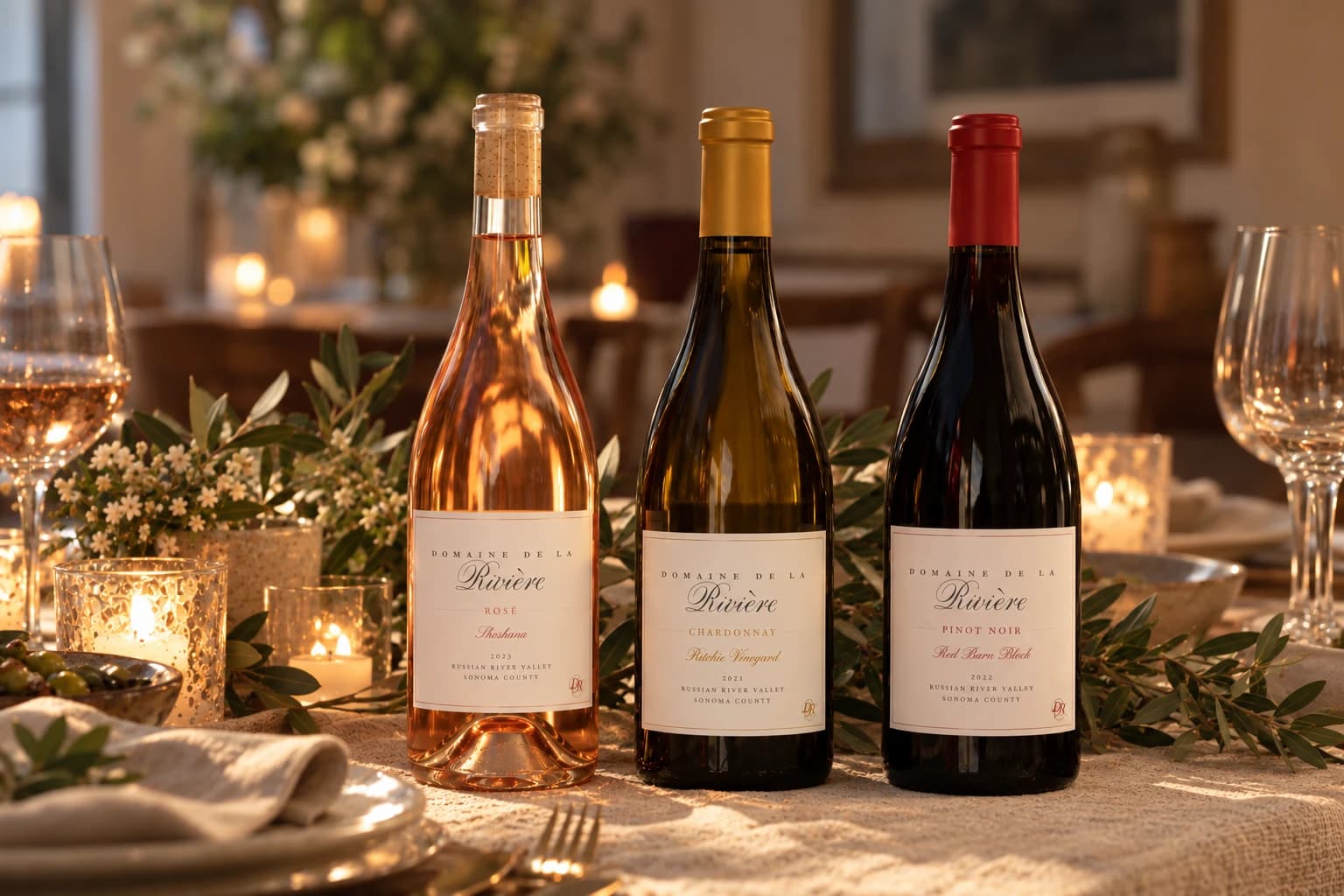
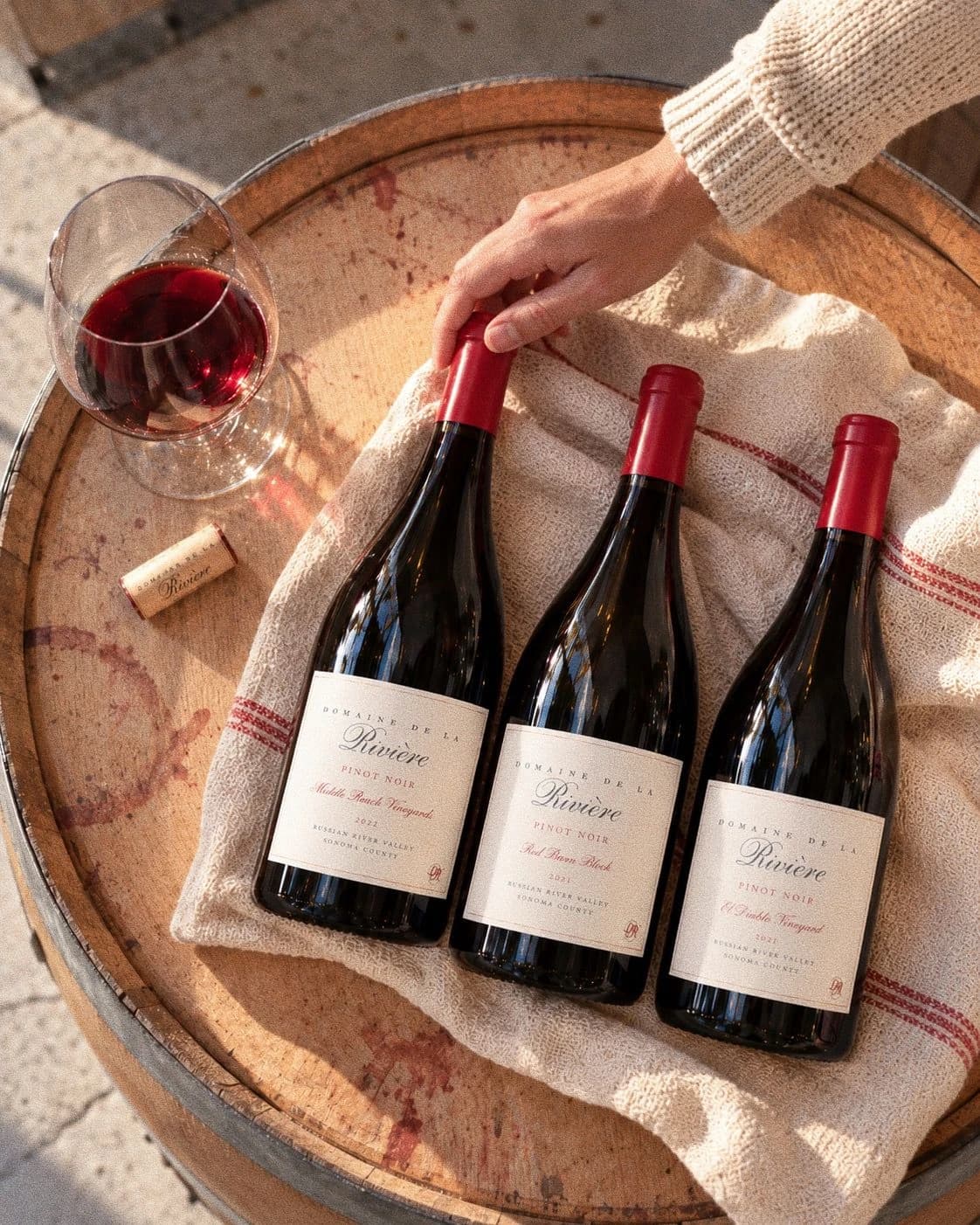
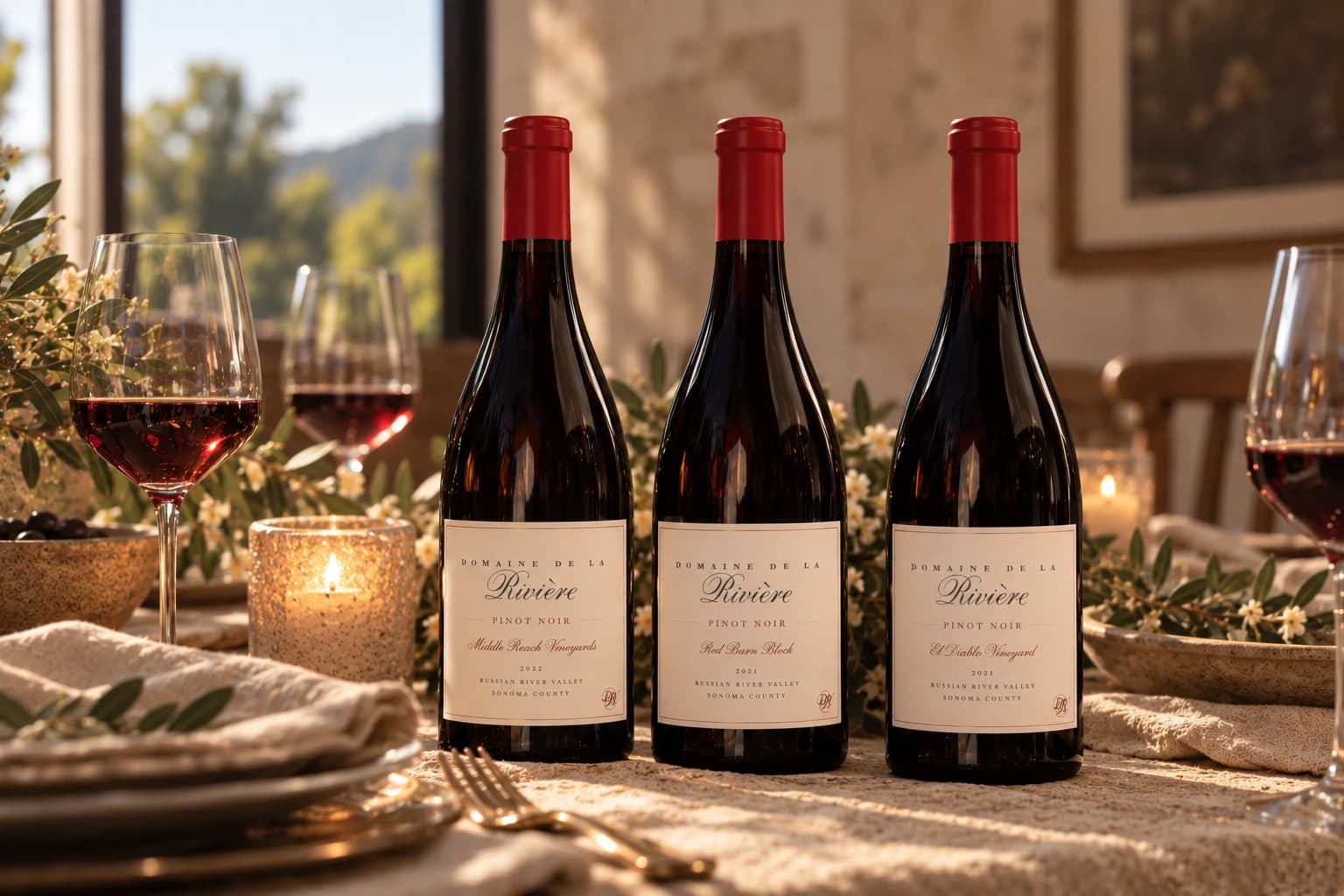
The corporate wine gifts we send
The short version: these are the estate wines we send most for corporate gifting, matched to the recipient and budget. We handle multi-address orders, a note on each, and state-by-state shipping directly; the reasoning follows below.


Shop the Set
Curated collections



Why is wine a good corporate gift?
Wine works as a business gift because it is personal without being presumptuous. A bottle with a clear origin marks the occasion, is welcome across a wide range of people, and does not need a logo to feel considered. It suits both employees and clients, and — unlike branded merchandise — it is consumed rather than stored or discarded.
Provenance is what separates a memorable client wine gift from a generic one. A bottle a recipient can place — a named region, a specific vineyard, a family — reads as chosen, and is often kept for an occasion rather than forgotten. A bottle from a small estate also carries a story the sender can tell in the note, which a case of mass-market wine cannot.
Wine is not the right gift for everyone. A recipient list of any size will include people who do not drink, for reasons of health, faith, or preference, and people in roles or organizations that cannot accept alcohol. Plan an equivalent non-alcoholic alternative for them from the start rather than as an afterthought; a considerate substitute reads better than a bottle that has to be passed along.
What wine should you give employees versus clients?
Match the gift to the relationship and give everyone in the same group the same thing. Employees are well served by a single well-chosen bottle at $40–$70. Client gifts, where the aim is to signal how much the relationship matters, tend toward a single-vineyard red at $80–$120 or a pair. A tasting or membership suits a standout relationship of either kind.
| Recipient | Give | Per-recipient budget | Notes |
|---|---|---|---|
| Employees, whole team | One bottle, the same for everyone | $40–$70 | Fairness matters more than the label; a dry rosé or an estate Chardonnay travels well |
| Coworkers, peer exchange | One approachable bottle | $25–$50 | Respect the exchange cap; check the person drinks |
| Managers and leadership | One single-vineyard bottle with a note | $80–$110 | Same tier across the leadership group |
| Clients and partners | A single-vineyard red, or a white-and-red pair | $80–$200 | Check the client's gift policy first |
| Top accounts, referral sources | A pair, a case, a membership, or a hosted tasting | $200 and up | An experience for a group often beats a case for one person |
Employee holiday gifts
The rule for employee holiday gift ideas is parity: everyone at the same level receives the same gift, and the difference between levels, if any, is small. One good bottle from a named producer, shipped to each person's home with a short note from a leader, does more for morale than a heavier gift box of unrelated things. For a distributed or remote team, wine has the added advantage of arriving the same way for everyone, wherever they live.
Holiday gifts for coworkers
Peer-to-peer gifts at work should stay light. A single bottle in the $25–$50 range, or a dry rosé for a Secret Santa, is generous without creating an obligation. Ask, or quietly check, whether the person drinks before buying wine; a good coffee or a food gift is the better choice if they do not.
Client wine gifts
Client gifts are judged on thought, not weight. One single-vineyard bottle with published scores, and a handwritten note that mentions something specific about the year's work, is a stronger gift than a case with a printed card. Before sending, check whether the client's organization has a gift policy or a value cap — many public companies, government bodies, and regulated firms do — and stay under it or send to the individual's home if their policy allows personal gifts.
If you asked us for a name, we would point to our 2021 Two Forces Pinot Noir, which scored 95 points from Wine Enthusiast and took a Double Gold at the American Fine Wine Competition, or the Ritchie Vineyard Chardonnay — the 2022 scored 96 points from The Tasting Panel and 95 with an Editor's Choice from Wine Enthusiast. Both are $90–$95, and both are bottles a client can look up and find the same numbers.
How much should you budget per recipient for corporate wine gifts?
Plan on $40–$70 a bottle for employees and $80–$120 for clients, plus shipping, which for wine typically runs $15–$30 per address depending on distance. A list of 40 employees at $60 plus shipping is roughly $3,000–$3,600; ten clients at $100 plus shipping is about $1,200–$1,300. Shipping is a larger share of the cost than most first-time buyers expect.
| List | Bottle | Shipping (est.) | Approximate total |
|---|---|---|---|
| 10 clients | $100 | $20 each | $1,200 |
| 25 employees | $60 | $20 each | $2,000 |
| 40 employees | $60 | $20 each | $3,200 |
| 100 employees | $45 | $20 each | $6,500 |
Two ways to reduce the cost per recipient without reducing the gift: ship a pair or a half-case to one address rather than single bottles to many, and choose one wine for the whole list so the winery can pack and label in one run. Where a team shares an office and the company's policy allows alcohol on site, a single delivery to the office with bottles handed out at a gathering removes most of the shipping cost.
On taxes: in the United States, the deduction for business gifts is limited to a small fixed amount per recipient per year, and rules differ for gifts to employees, which may be treated as compensation. How that applies to a particular company, and whether a gift or an event is the better route, is a question for your accountant or tax advisor, not for a winery.
How do you send wine gifts to many addresses at once?
Sending one wine to a whole team or client list — many small shipments to many addresses — is usually arranged directly with the winery rather than through a standard checkout. The sender provides the recipient list, any personal notes, and the timing; the winery confirms which states can be reached, packs and labels each shipment, and schedules delivery.
The work in a multi-address order is compliance and coordination, not just packing. Each shipment must go to a state that permits direct wine shipping, cannot go to a P.O. box, and requires an adult 21 or older to sign on delivery. Across a large list that is a lot to manage well, which is why most wineries handle corporate orders by email or a dedicated form instead of a self-service cart.
This is what we do for companies. Send the list, the notes, and the timing to marla@domaineriviere.com, and we confirm which states we can reach (most U.S. states, through Vinoshipper), pack each shipment, and enclose each card ourselves. We do not publish volume tiers; we would rather see the list first and build the order with you.
- Build the list in a spreadsheet: recipient name, full street address (no P.O. boxes), state, phone number for the carrier, and the note text for each person.
- Send the list to the winery and ask which addresses fall outside the states it can ship to; plan an alternative for those recipients.
- Choose one wine, or one pair, for the whole list. One SKU across the order is what makes packing and labeling fast.
- Confirm the ship date, and whether any addresses in cold-weather states may be held for a safe window.
- Ask for tracking numbers per recipient so someone can follow up on missed-signature attempts before the carrier returns a package.
Should you ship corporate wine gifts to the office or to homes?
Ship client gifts to the office unless the client asks otherwise, and employee gifts to homes. An office has someone at the front desk to sign during the day, but many workplaces restrict alcohol deliveries and some clients cannot accept them at all. A home delivery is more personal, and the only option for remote staff, but needs an adult present.
Three things to check before choosing. First, the recipient's employer policy: hospitals, schools, government offices, and some regulated companies prohibit alcohol on the premises, and a bottle delivered there is refused or awkward. Second, the building: a corporate campus with a mailroom will sign for wine; a shared coworking space often will not. Third, the person: for remote employees, a home address is the only option, and for a client who works from home, ask before sending anything to a house.
Where you ship also changes the compliance picture. The destination state, not the sender's, sets the rules, and a gift to an employee in a state the winery cannot reach has to become something else — a tasting kit for a virtual event, a non-alcoholic gift, or a gift card. Sort the list by state before you sort it by recipient.
Are there rules for shipping wine as a corporate gift?
Yes. Direct-to-consumer wine shipping is regulated state by state, so where a gift can go depends on the destination. Every shipment requires an adult 21 or older to sign on delivery, none can go to a P.O. box or APO/FPO address, and the recipient's state must permit it. These rules apply per recipient, which is what makes a large list take planning.
The federal framework for wine sits with the Alcohol and Tobacco Tax and Trade Bureau; the specific permissions, volume limits, and licensing sit with each state, and a winery ships only into states where it holds a direct-shipping permit or uses a licensed fulfillment partner that does. A corporate list should therefore be checked against shippable states before it is finalized, and gifts should go to addresses where someone will be present to sign during the day.
- Destination state rules govern; some states do not allow direct wine shipments to consumers at all.
- An adult 21 or older must sign for every package; carriers will not leave wine unattended.
- No P.O. boxes, no APO/FPO addresses, and no forwarding services.
- A company is a sender, not a licensee — it cannot buy in bulk and reship wine itself across state lines.
- If your industry restricts gifts to clients (finance, healthcare, government contracting), your own compliance policy applies before any shipping rule does.
Can you put your company logo on a wine bottle?
Yes. The lasting way is etching: the logo or message is cut permanently into the glass, so it stays after the wine is gone. The simpler way is the winery's own bottle, gift-wrapped, with a note from your company. Pricing depends on the quantity, the wine and the bottle size.
An etched mark is restrained: usually a logo, a name or a short line, in one tone with no colour. People tend to keep the bottle on a shelf long after the wine is gone. A standard bottle with a note asks for no design work at all; your words go on the card and the wine does the rest. Some wineries also print private labels with artwork and colour. We keep to etching and our own label.
| Etched bottle | Our bottle with your note | |
|---|---|---|
| Permanence | Permanent; cut into the glass and kept after the wine is gone | The note is the keepsake; the bottle carries our own label |
| Design | Logo, names or a short message; one tone, no colour | Your words on the card; no design work |
| What sets the price | Quantity, wine and bottle size | The wine and the number of gifts |
| Best for | Milestones, key clients, gifts meant to be kept | Large or late lists, mixed tastes, simple thank-yous |
A real example: last holiday season we etched bottles for a private-equity firm's holiday gift. The request is a common one, and the runs we're asked about most are 100 to 300 bottles. We etch our own Rosé, Chardonnay and Pinot Noir, in 750 ml bottles or magnums; the magnum is the format people most often choose for an etched keepsake. Pricing is set per order and depends on three things: how many bottles, which wine, and the bottle size.
Timing depends on the size of the order and your delivery date. You approve a digital proof before anything is made. Shipping follows the same rules as any wine gift: an adult 21 or older signs for each box, direct shipping is limited to the states that allow it, and nothing goes to a P.O. box.
How do you personalize corporate wine gifts?
Start with the note. A two-line message from a named person (a manager, a founder, an account lead) enclosed with each bottle costs nothing and does more than packaging. A logo belongs on the gift only when it is done well: etched into the glass, on wine worth drinking, not printed on a box.
For a list of any size, write one base message and vary a line per person or per group: the project you worked on together, the office they are in, the year they joined. Send the notes to the winery as a column in the same spreadsheet as the addresses so each one is enclosed with the right bottle. If a printed card is easier at volume, have it signed by hand by the person the gift is from.
Personalization can also mean the format rather than the words. For a team that works together, a hosted virtual tasting turns a list of parcels into a shared event. We run these often: a flight ships to each guest ahead of time, then the winemaker or the family leads a live hour for a remote team or clients across the country, and it works for people in different states as long as each address can receive wine. For a group that can travel, we host seated tastings in Windsor from a table of 2 up to 50, and arrange client dinners, off-sites, and buy-outs around the occasion. A Les Clubs membership — a half-case or a full case, twice a year — is the version of this for one standout relationship.
How far ahead should you order corporate wine gifts?
Order earlier than you would for a single bottle — confirm the list and the wine by mid-November, and ship in the first two weeks of December. December is the busiest shipping window of the year, carriers publish holiday cut-off dates annually and they change, and coordinating many addresses, each needing a signature from someone 21 or older, takes lead time.
| When | What to do |
|---|---|
| September–October | Set the budget, decide employee versus client tiers, and ask the winery about availability — small producers sell out of specific wines |
| Early November | Finalize the recipient list and addresses; confirm shippable states; collect note text |
| Mid-November | Place the order; agree a ship date; plan alternatives for non-drinkers and unreachable states |
| First two weeks of December | Shipments go out, ahead of carrier cut-offs and with room for weather holds and missed signatures |
| Week before the holiday | Check tracking; chase any package on a second delivery attempt |
The earlier a corporate order is placed, the more smoothly it lands: small wineries produce limited quantities, so an early conversation secures the wine before the rush, and shipments can be scheduled to arrive when intended. We are one of those small producers — an October email is often the difference between the wine you wanted and the wine that is left. A firm delivery date — an event, a year-end deadline — is the strongest reason to start early. Gifts sent in January avoid the rush entirely and arrive when nothing else does.
Tell us your list, budget, and timing and we'll build the order with you: our wines as they are with a note in each box, or custom etched bottles, shipped to one address or many.
Custom & Corporate GiftsFrequently asked questions
- Why is wine a good corporate or employee gift?
- Wine is personal without being presumptuous, and a bottle with a clear origin marks the occasion without needing a logo. It is welcome across a wide range of people and is consumed rather than stored. Where a generic gift is forgotten, a wine with real provenance is often kept for an occasion. Plan an alternative for recipients who do not drink.
- What should you give employees versus clients?
- Employees are well served by one well-chosen bottle in the $40–$70 range, the same for everyone at the same level. Client gifts, where the aim is to signal how much the relationship matters, tend toward a single-vineyard red at $80–$120 or a white-and-red pair. An experience like a hosted tasting or a membership suits a standout relationship of either kind.
- How much should a company budget per person for holiday wine gifts?
- Plan on $40–$70 a bottle for employees and $80–$120 for clients, plus roughly $15–$30 per address for wine shipping. A list of 40 employees at $60 plus shipping comes to about $3,200; ten clients at $100 plus shipping about $1,200. Choosing one wine for the whole list and shipping pairs where possible lowers the cost per recipient.
- Can you send wine gifts to many employees or clients at different addresses?
- Yes, though it is usually arranged directly with the winery rather than through a standard checkout. The sender provides the recipient list, notes, and timing; the winery confirms shippable states, packs each shipment, and schedules delivery. Each delivery needs an adult 21 or older to sign and cannot go to a P.O. box.
- Is it better to ship corporate wine gifts to the office or to homes?
- Client gifts usually go to the office, where someone can sign during the day, unless the client's workplace restricts alcohol deliveries or has a gift policy. Employee gifts usually go to homes, which is more personal and the only option for remote staff, but an adult 21 or older must be present. Check the destination state before either.
- Are there rules for shipping wine as a corporate gift?
- Yes. Direct-to-consumer wine shipping is regulated state by state, so coverage is limited. Every shipment needs an adult 21 or older to sign on delivery, none can go to a P.O. box, and the recipient's state must permit it. A company cannot buy in bulk and reship wine itself across state lines, and its own gift and compliance policies apply first.
- Are corporate wine gifts tax deductible?
- Only in part. In the United States the deduction for business gifts is capped at a small fixed amount per recipient per year, and gifts to employees may be treated differently from gifts to clients. This guide is not tax advice; ask an accountant or tax advisor how the rules apply to your company before deciding between gifts and an event.
- How far ahead should we order corporate holiday gifts?
- Confirm the wine and the list by mid-November and ship in the first two weeks of December. Small producers sell out of specific wines, carriers publish holiday cut-off dates that change each year, and coordinating many addresses, each needing an adult signature, takes lead time. Gifts sent in January avoid the rush entirely.
- What is private-label wine?
- Private-label wine is wine made by a winery and sold under a label you design: the winery makes the wine, and you supply the artwork or wording and approve a proof. Domaine de la Rivière doesn't make private labels. We etch your logo, names or message into the glass of our own Pinot Noir, Chardonnay or Rosé instead, or send our bottles gift-wrapped with your note.
- Can you get custom wine labels for corporate gifts?
- Yes, from wineries that print private labels. Domaine de la Rivière doesn't; for a branded gift we etch your logo or message permanently into the glass of our own wine, in 750 ml or magnum, send a digital proof for approval, and ship to one office or to each recipient. Pricing depends on quantity, wine and bottle size.
- What are custom wine bottles, and how are they different from custom labels?
- Custom wine bottles usually means etched glass: the logo or message is cut permanently into the bottle, so it lasts after the wine is gone. A custom label is printed and stuck on, which allows colour and artwork. We etch our own Rosé, Chardonnay and Pinot Noir, in 750 ml or magnum; we don't print custom labels.
- How does Domaine de la Rivière handle corporate gifting?
- We take corporate orders directly: send us the recipient list, the notes, and the timing by email rather than through a checkout, and we confirm shippable states (most U.S. states, through Vinoshipper), pack each shipment, and enclose each card. Wines run $40 to $110, including Two Forces Pinot Noir 2021 (95 points, Wine Enthusiast; Double Gold, American Fine Wine Competition). We also host virtual tastings with flights shipped ahead, in-person tastings for 2 to 50, and private events. We also etch logos and messages into the glass of our own wine for corporate gifts, quoted per project. Email marla@domaineriviere.com or start from our custom and corporate gifts page.
References